Why you can't talk politics, even with people you respect
When smart people get more polarized instead of less, when conversations become loyalty tests, when the exits are always easier than the engagement, someone is winning. It's not the people in the argument.

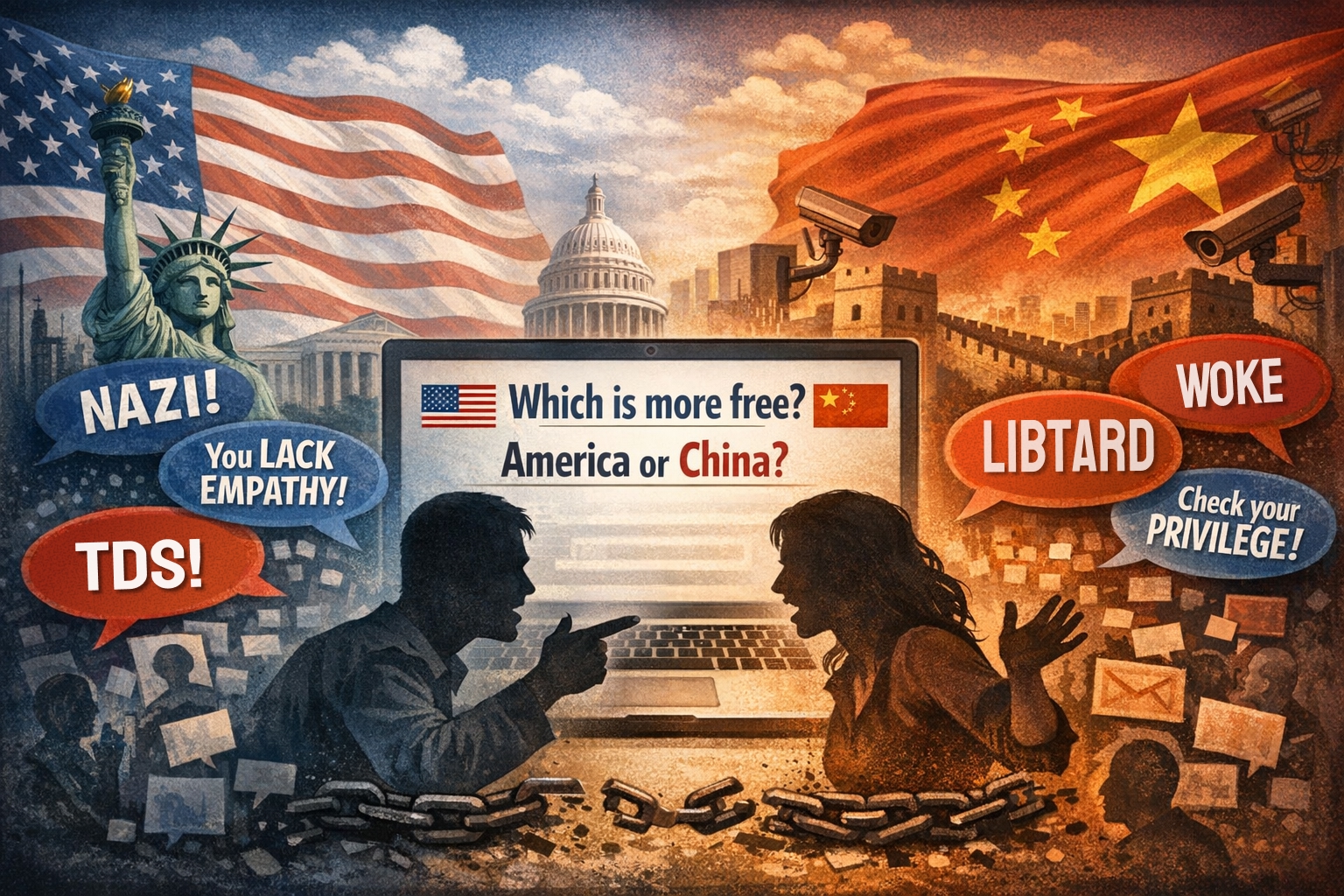
I recently shared an opinion online as a response to an anti-Trump post and asked what I thought was a simple question: do you think America or China is more free? I wasn't trying to start a fight. I'd stated my view (I trust America more than China or Russia as a geopolitical ally), but I wasn't demanding anyone agree. I was genuinely curious whether people could engage with a comparative question about freedom and governance.
Within hours I'd been called a Nazi sympathizer, told I lack empathy, and informed that my question "says a lot about me." One person told me to look up a specific ICE incident. Another compared America to Nazi Germany. Someone brought up that I have a kid and a spouse who isn't white, as though that was relevant to a question about which superpower you'd rather have as an ally.
Nobody answered the question.
I want to be clear that I'm not writing this to relitigate that argument or to prove I was right. I'm writing it because I think something interesting happened in that thread, and it connects to research I've been reading about why political conversations go sideways even between people who otherwise respect each other.
The first thing worth noticing is the structure of the responses I got. When I asked a geopolitical question, people responded with moral accusations. When I tried to bring the conversation up to a systemic level (comparing governance structures between nations), they pulled it back down to specific incidents and emotional appeals. When I pointed out that none of this addressed my actual question, I was told I lacked empathy.
Psychologist Robert Jay Lifton has a term for this kind of response. He calls it a thought-terminating cliché: a phrase that functions to end an argument without actually engaging with it. Lifton developed this concept in his 1961 study of Chinese Communist indoctrination programs, where he observed how certain loaded phrases could shut down critical thinking by compressing complex problems into simple, emotionally satisfying formulations. "Nazi," "racist," "you lack empathy," "that says a lot about you" all function this way. They feel like moral clarity, but they're actually exits from the conversation rather than contributions to it.
This isn't a left-wing problem specifically. The right has its own set of thought-terminating clichés: "Trump Derangement Syndrome," "libtard," "facts don't care about your feelings," "go woke go broke." The content differs but the function is identical. These phrases signal tribal membership and shut down inquiry. They're substitutes for engagement.
Here's where it gets uncomfortable, especially if you're educated and consider yourself a critical thinker. Yale researcher Dan Kahan has spent years studying what he calls "identity-protective cognition," which is the tendency to evaluate evidence based on whether it supports beliefs that are important to your group identity. You'd expect education and scientific literacy to protect against this, but Kahan's research shows the opposite: the most educated and numerate people are often the most polarized on politically contentious topics, because they're better at constructing sophisticated arguments for positions they already hold. Intelligence doesn't make you a better judge of evidence. It makes you a better lawyer for your existing beliefs.
Kahan ran an experiment where he gave people a math problem about whether a skin cream worked. Most people got it right. Then he gave a structurally identical problem, same numbers, same logic required, but framed it as being about whether a gun control policy worked. Suddenly responses split along partisan lines, and the most mathematically capable participants were more polarized, not less. They were using their skills to arrive at the answer their tribe preferred.
Social psychologist Jonathan Haidt offers a complementary explanation. His research on moral foundations theory suggests that liberals and conservatives aren't just disagreeing about facts; they're operating from different moral frameworks that weight different values. Liberals tend to prioritize care (preventing harm) and fairness (equality), while conservatives also weight loyalty, authority, sanctity, and proportionality (people getting what they deserve). These frameworks shape what questions feel important and what answers feel satisfying.
This helps explain what happened in my thread. When I asked "is America freer than China," I was asking about institutional structures, constitutional protections, comparative governance. But to someone operating primarily from a care-focused moral framework, that question might sound callous: how can you talk about abstract freedom when ICE is separating families right now? From their perspective I wasn't asking a legitimate question; I was deflecting from real human suffering to score rhetorical points. From my perspective they were evading a straightforward comparative question with emotional appeals and subject changes. We weren't really disagreeing. We were failing to communicate at all because we were operating from different premises about what the conversation was even about.
I also want to acknowledge that cherry-picking works in both directions. For every meme showing the worst things a politician has done, there's a counter-meme showing heartwarming anecdotes about the same person. Neither is the full picture. People aren't the sum of their worst moments or their best ones, and our information environment constantly serves us curated narratives designed to make us feel rather than think.
Something interesting happened after I pointed all this out in the thread. I named the pattern we'd fallen into, explained what thought-terminating clichés are, acknowledged that people on the right do the same thing, and restated my actual question: whether America or China is more free, and which you'd prefer as an ally.
One person came back with a genuine answer. She said she thinks America is becoming less free every day and moving toward a China-like government. I don't fully agree with her assessment, but that's a real position we can actually discuss. I told her I appreciated the response, that I feel something similar happening in Canada, and that we might just disagree about which authorities we trust to protect freedom. I caught myself about to use a term that might be loaded ("illegals") and instead wrote out the alternatives and said I wasn't trying to weaponize language. It was a bit clumsy, but It kept the conversation going.
We still disagree. She thinks America is sliding into authoritarianism under Trump. I think prior administrations were doing similar things but were better at hiding it. But we found the actual disagreement: not whether freedom matters, but who we trust to protect it. That's something two people can talk about.
I don't have a clean prescription for how to fix political discourse, but I've started noticing a few things in myself. I notice when I'm reaching for a label instead of an argument, when I'm pattern-matching someone to a stereotype instead of responding to what they actually said, when I'm deploying my reasoning skills to win rather than to understand. I try to ask myself whether there's any chance I'm missing something, not because I think I'm always wrong but because the inability to imagine being wrong is a sign that I've stopped reasoning and started defending. I try to remember that the person on the other side of the argument is probably scared about a lot of the same things I'm scared about, even if we've landed on different explanations and solutions.
The question I keep coming back to is who benefits from all this. When smart people get more polarized instead of less, when conversations become loyalty tests, when the exits are always easier than the engagement, someone is winning. It's not the people in the argument.
Maybe that's worth thinking about.