The Musqueam Agreement Could Bankrupt You, and the Media Is Lying About It
How the Musqueam Agreement, the Cowichan Precedent, and the Canadian Constitution Combine to threaten every homeowner in Metro Vancouver, and ultimately across Canada

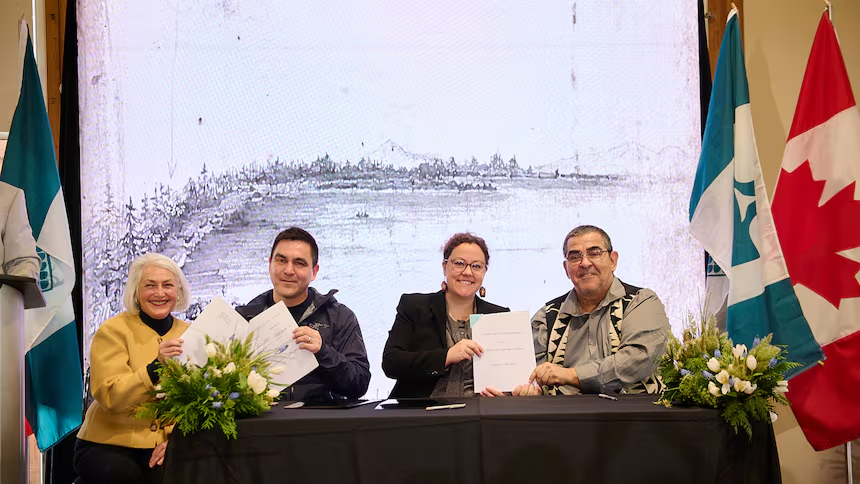
On February 20, 2026, the Government of Canada quietly signed three agreements with the Musqueam Indian Band recognizing Aboriginal rights, including Aboriginal title, across an enormous swath of Metro Vancouver. The territory covered spans from Howe Sound to Indian Arm, from Burrard Inlet to the Fraser River. It encompasses Vancouver, Richmond, Burnaby, parts of Delta, North Vancouver, West Vancouver, UBC, Coquitlam, New Westminster, and Surrey. Nearly two million people live within this territory.
Both the federal government and the Musqueam have said the same thing: this will not affect private property. The media has largely repeated this assurance without scrutiny. On social media, anyone who questions it is dismissed as stupid or uneducated. But the law tells a very different story. If you own property in Metro Vancouver, or anywhere in Canada where land was never ceded by treaty, you need to understand what that law actually says, because nobody in power is being honest with you about it.
I have prepared this article with citations to court decisions, constitutional law, and news sources. You should verify every assertion I make. Don't trust the media. Don't trust me. Look it up yourself. Some sources are linked in the body text but the rest are at the bottom.
What the law actually says about Aboriginal Title
To understand why the reassurances are hollow, you need to understand three things about Aboriginal title as defined by the Supreme Court of Canada. These are not opinions. These are established legal principles confirmed in binding court decisions.
First: Aboriginal title is inalienable. It cannot be transferred, sold, or surrendered to anyone other than the Crown. The Supreme Court stated this explicitly in Delgamuukw v. British Columbia (1997):
"Aboriginal title is sui generis, and so distinguished from other proprietary interests, and characterized by several dimensions. It is inalienable and cannot be transferred, sold or surrendered to anyone other than the Crown." - Chief Justice Lamer, Delgamuukw v. British Columbia [1997] 3 S.C.R. 1010
Second: Aboriginal title cannot be mortgaged. The Centre for Constitutional Studies at the University of Alberta confirms that under Aboriginal title, land "can only be sold to the Crown (it cannot be mortgaged, for example)." This is a direct consequence of its inalienable nature. You cannot pledge as collateral something you cannot alienate.
Third: Aboriginal title is constitutionally protected and cannot be extinguished. Section 35 of the Constitution Act, 1982 states: "The existing aboriginal and treaty rights of the aboriginal peoples of Canada are hereby recognized and affirmed." Since 1982, the Crown can no longer unilaterally extinguish Aboriginal rights. Critically, Section 35 sits outside the Charter of Rights and Freedoms, which means it cannot be overridden by the notwithstanding clause. There is no legislative shortcut around this.
None of these are fringe legal theories. These are binding principles from the highest court in the country. And they create an inescapable logical problem for anyone who tells you Aboriginal title recognition won't affect your property.
A bit of history: Aboriginal Title and Property Rights
Aboriginal title was not created by the Constitution. It is a common law doctrine developed through Supreme Court case law, rooted in the prior occupation of land by Indigenous peoples before Crown sovereignty. But Section 35 of the Constitution Act, 1982 gave it constitutional protection, which means it can no longer be extinguished by ordinary legislation. The courts have been progressively expanding its scope ever since, from a limited right of use in the 1970s, to a full proprietary interest that is 'senior' to fee simple in 2025. And because Section 35 sits outside the Charter, the notwithstanding clause cannot override it.
The irony is that fee simple property ownership has an almost identical legal origin. Fee simple title is also a common law doctrine. It was not created by the Canadian Constitution either. It evolved through centuries of English common law and was carried into Canadian law through colonial reception. The critical difference is what happened in 1982. When the Constitution was patriated, Aboriginal title was given constitutional protection through Section 35. Fee simple title was not. Pierre Trudeau deliberately excluded property rights from the Charter of Rights and Freedoms to secure provincial agreement on patriation. The result is a constitutional asymmetry: two common law property doctrines, both centuries old, both foundational to the legal system, but only one was elevated to constitutional status. That is why Aboriginal title is now 'senior' to fee simple. It's not because Aboriginal title is inherently superior as a property right. It's because one got a constitutional shield and the other didn't. Every homeowner in British Columbia is paying the price for a political compromise made 43 years ago.
Property rights were not accidentally forgotten. Pierre Trudeau proposed including them in the Charter as early as 1968 and pushed for their inclusion repeatedly during patriation. They were stripped out in January 1981 under pressure from provincial premiers, particularly Saskatchewan's Allan Blakeney, who feared the clause would constrain provincial control over natural resources, and from the federal NDP, who threatened to withdraw support for the entire constitutional package if property rights were included. Chrétien, negotiating on Trudeau's behalf, dropped the clause to save the deal. A later attempt to include property rights in the Charlottetown Accord in 1992 died with the rest of that agreement in a national referendum. The result is that Canada remains one of only two OECD countries whose constitution does not protect property rights or guard against unjust seizure. That political compromise, made under duress to appease socialist premiers and the NDP 43 years ago, is now the reason a court can declare Aboriginal title 'senior' to your home.
The Cowichan precedent: what the court actually ruled
In August 2025, Justice Barbara Young of the B.C. Supreme Court issued a decision in Cowichan Tribes v. Canada (Attorney General), 2025 BCSC 1490. The trial ran 513 days over five years – the longest in Canadian history – and produced an 863-page judgment. The ruling established several unprecedented legal precedents:
Aboriginal title was declared "senior" to fee simple ownership. For the first time, a Canadian court placed Aboriginal title above the standard form of private property ownership in the legal hierarchy. The court declared that fee simple titles held by Canada and the City of Richmond were "defective and invalid" where they overlapped with recognized Aboriginal Title.
The Land Title Act does not protect against Aboriginal Title. The court ruled that the indefeasibility provisions of B.C.'s Land Title Act (the legal foundation that every property owner, bank, and investor relies upon) do not apply against Aboriginal title. Property law expert Thomas Isaac of Cassels Brock & Blackwell LLP called this "devastating" to landowners.
Private titles were declared an unjustifiable infringement. While the Cowichan did not seek to invalidate private titles in this proceeding, the court found that the granting of those private titles by the Crown was an unjustifiable infringement on Cowichan Aboriginal title and ordered negotiations to resolve the conflict. The court left the door wide open for future challenges.
Pay close attention to that last point. The Cowichan chose not to challenge private titles in this case. They didn't have to. The court volunteered the finding that those titles are an infringement on Aboriginal title anyway. The legal groundwork for future challenges is laid.
The Musqueam Agreement: what "won't affect private property" actually means
Now apply what the law says to what just happened with the Musqueam.
On February 20, 2026, the federal government signed three agreements with the Musqueam Indian Band. The most consequential is the šxʷq̓ʷal̕təl̕tən Rights Recognition Agreement which formally recognizes that the Musqueam have "unextinguished Rights and Title within the Musqueam Territory." That territory covers most of Metro Vancouver.
The agreement says it does not "create, amend, establish, abrogate or derogate" from Musqueam title. It is not a treaty or a formal land claim. Both the government and the Musqueam say it won't affect private property. Chief Wayne Sparrow has stated: "Musqueam is not coming for anyone's private property."
Here is the problem: it doesn't matter what the Musqueam say they want. The legal characteristics of Aboriginal title follow automatically from its recognition.
If Musqueam Aboriginal title is recognized across Metro Vancouver, then by operation of law:
That title is inalienable, ie: it cannot be sold or transferred to private parties. It cannot be mortgaged. It is constitutionally protected and cannot be extinguished without Aboriginal consent. And if the Cowichan precedent holds on appeal, Aboriginal title is "senior" to fee simple, and the Land Title Act's protections do not apply against it.
The Musqueam leadership may genuinely have no current intention to pursue private property. But future leadership may think differently. Band councils change. Political pressures shift. And the legal framework that would enable such claims is being laid right now, with the explicit endorsement of the federal government. Thomas Isaac put it bluntly: "I know what title means at law, there's no debate. It's the exclusive right to that land over and above everyone else, including the Crown government, according to the Supreme Court of Canada."
This is not a conspiracy theory. This is what the law says. And the media's failure to explain this to the public is either incompetence or deception.
It's already happening: mortgages, investment, and the market
The reassurances from politicians and First Nations leaders have not prevented the market from reacting. Markets don't care about press releases, they care about risk. The risk profile of property under Aboriginal title claims is already being repriced.
Mortgage denials: At a standing-room-only meeting in Richmond in October 2025, homeowners reported being denied mortgage renewals by their banks. At least one longtime resident stated on camera that his bank had already refused to renew his mortgage. The City of Richmond asked affected property owners to come forward so they could be added as intervenors in the legal proceedings.
The $100 million project collapse: Richmond Councillor Alexa Loo reported that a local manufacturing company was refused $100 million in financing because of the Cowichan ruling. The company owned land in the affected area and had plans to build a facility. Their lender, the National Bank, pulled the deal.
The Versante Hotel: An Ontario hotel company had put down a deposit to purchase the 14-storey Versante Hotel in Richmond, a property not even inside the Cowichan title area, but withdrew its offer nine days after the ruling was issued. The hotel was eventually sold to a Hong Kong purchaser for $51.5 million, well below the $113 million owed on the property. Colliers confirmed in court documents that the buyer cited the Cowichan ruling as the reason for pulling out.
Montrose Properties: The largest private landowner in the Cowichan title area, Montrose Properties, disclosed in a 31-page court filing that its lender refused to continue financing a warehouse project and a prospective tenant pulled out, both citing the Cowichan ruling. The company had already spent $7.5 million and planned to borrow another $35 million to complete construction.
BC Assessment declines: In the 2026 assessment roll, major non-residential properties in the disputed area saw unusually large declines. A 68-acre vacant industrial waterfront property dropped from approximately $197 million to $133 million. Another 61-acre property fell from over $164 million to nearly $111 million. Both declines were entirely in land value, not structural.
These are not hypothetical scenarios. This is happening now, and it's happening in the Cowichan area alone, roughly 800 acres in southeast Richmond. The Musqueam territory encompasses orders of magnitude more land and property value.
The math problem: $150 million against trillions
Premier David Eby has pledged $150 million in loan guarantees for property owners in the Cowichan title area. That’s currently $100 million for Montrose Properties and $54 million for smaller owners. However, property tax experts representing Richmond homeowners have estimated the actual cost could reach $1 billion for the Cowichan area alone.
Now consider the scale of the Musqueam territory.
The total assessed value of all real estate in British Columbia is approximately $2.75 trillion across 2.23 million properties. A significant portion of that value sits within Musqueam traditional territory. Metro Vancouver's benchmark home price as of December 2025 was $1,114,800. The median home sale price across all types was $913,000 in 2025. There are approximately 1.14 million properties in the Lower Mainland alone.
If Aboriginal title recognition leads to even modest financing uncertainty across the Musqueam territory, and the Cowichan case proves it does, the economic impact would be measured not in hundreds of millions but in hundreds of billions. A 10% decline in property values across Metro Vancouver alone would represent over $100 billion in lost equity. A 20% decline, which is not unreasonable given that properties in the Cowichan area are already seeing lenders refuse to finance them, would be over $200 billion.
The province of British Columbia is already running historic deficits. The 2026 budget envisions a largely stagnant economy and dizzying rises in government debt. There is no fiscal capacity to backstop a property crisis of this magnitude. The $150 million Eby has offered is a rounding error against the potential exposure.
The South Africa parallel
For anyone who thinks this couldn't lead to actual property loss, South Africa offers an instructive case study.
South Africa's post-apartheid constitution included provisions for land reform and expropriation in the public interest, subject to compensation. In 2017, the ANC government moved to amend the constitution to allow expropriation without compensation. The mere political discussion of this policy caused widespread disinvestment, with wealthy South Africans moving funds offshore and international companies selling assets.
In 2025, South Africa passed a new Expropriation Act that, while largely requiring compensation, introduced provisions for "nil compensation" in limited circumstances. The first test case was the Ekurhuleni expropriation of a 34-hectare property in Gauteng, which has been in litigation since 2019. The city government is refusing to pay any compensation. Legal experts warn that if this case is allowed to stand, property valuations for all similar properties would need to be adjusted downward, with ripple effects throughout financial markets.
The parallels to British Columbia are clear. Both situations involve a historically dispossessed group asserting prior rights to land that is now occupied and developed. Both involve constitutional frameworks that empower those claims. Both have governments publicly reassuring property owners while simultaneously creating the legal infrastructure for those reassurances to prove hollow. And in both cases, the economic consequences of even the uncertainty, let alone actual expropriation, are devastating.
The key difference is that Canada's situation may actually be worse. South Africa at least required a constitutional amendment to expand expropriation powers. In Canada, the constitutional framework already exists. Section 35 already protects Aboriginal Title. The Cowichan ruling already established that Aboriginal Title is senior to fee simple. The Musqueam agreement already recognizes Aboriginal Title across Metro Vancouver. No further constitutional change is needed, just time and litigation.
The solution: a constitutional amendment to protect property rights
You didn’t think I’d write all this and not propose a solution, did you? We can solve this, but you need to wake up, and we need to work together!
So as I’ve established, Canada is one of the few Western democracies that does not constitutionally protect private property rights. The Canadian Bill of Rights (1960) references "enjoyment of property" but is a statutory document, not constitutionally entrenched. As stated prior, the Charter of Rights and Freedoms deliberately excluded property rights.
This omission is now coming home to roost. Without constitutional protection for Fee Simple property ownership, there is no legal counterweight to Section 35 Aboriginal rights. Courts have no basis to balance Aboriginal title against property rights because property rights have no constitutional standing.
The solution is a constitutional amendment that places Fee Simple private property rights on equal or superior footing to Aboriginal title. This amendment should establish that Fee Simple title lawfully granted and held in good faith is indefeasible and cannot be subordinated to subsequently recognized Aboriginal title claims. It should confirm that bona fide purchasers for value are entitled to rely on the land title system. And it should require that any reconciliation of Aboriginal Title with existing private property rights must be achieved through negotiation and fair compensation from the Crown, not through the invalidation of private titles.
This is not anti-reconciliation. It is the recognition that reconciliation cannot come at the cost of destroying the property rights of millions of people who purchased their homes and businesses in good faith. Even Thomas Isaac, one of Canada's leading Aboriginal law practitioners, has said the courts need to "confirm that indefeasible title remains indefeasible" or the province should support a constitutional amendment. He called this "leadership" and said it is "not offensive to reconciliation."
The economic case is existential. Property ownership is the foundation of middle-class wealth in Canada. Mortgages are the largest financial instruments most Canadians will ever hold. If the certainty of Fee Simple title is undermined across British Columbia or across any unceded territory in Canada, the result will be a crisis of confidence that makes the 2008 financial collapse look manageable. Banks cannot lend against property they cannot foreclose upon. Investors cannot invest in assets with uncertain title. Buyers cannot buy homes that may be subject to unchallengeable superior claims.
What you need to do
The media has failed you. The government is not being honest with you. The legal system is moving in a direction that, if unchecked, will fundamentally alter property ownership in this country. This is not happening in the future, it is happening right now!
Educate yourself. Read the Cowichan decision (2025 BCSC 1490). Read the Musqueam Rights Recognition Agreement, now available through Global News. Read the Delgamuukw and Tsilhqot'in decisions. Understand what Aboriginal title actually means in law, not what politicians tell you it means.
Contact your representatives. Demand that your MLA and MP explain how they intend to protect your property rights. The City of Richmond has published contact information for relevant federal and provincial representatives. Use it.
Demand a constitutional amendment. A property rights amendment to the Canadian Constitution is not a radical proposal, it is a necessary correction to a 43-year-old omission that is now being exploited. Reconciliation and property rights are not mutually exclusive, but they need to be balanced in the supreme law of the land.
Organize and protest. Over 650 people showed up to a single information meeting in Richmond. The majority of British Columbians support the appeal of the Cowichan ruling. This is NOT a fringe concern, it is a mainstream crisis being treated as a niche legal issue. Mass public demonstrations are needed to make the political class understand the urgency. The longer we wait, the more legal precedent accumulates, and the harder it becomes to reverse.
Support the appeals. The City of Richmond, the Province, the federal government, the Musqueam, and the Tsawwassen are all appealing the Cowichan decision. If you are a property owner in the affected area, contact the City of Richmond about becoming an intervenor. If you are outside the area, support organizations advocating for property rights protection.
The question before us is simple: Do Canadians have the right to own property? Right now, the answer is legally uncertain and getting more uncertain every day. If that is unacceptable to you, then it is time to act. Not next year. Not when the appeal is decided. Now.
Sources and References
- Cowichan Tribes v. Canada (Attorney General), 2025 BCSC 1490 (Justice Barbara Young, August 7, 2025)
- Delgamuukw v. British Columbia, [1997] 3 S.C.R. 1010 (Supreme Court of Canada)
- Tsilhqot'in Nation v. British Columbia, 2014 SCC 44 (Supreme Court of Canada)
- R v. Sparrow, [1990] 1 S.C.R. 1075 (Supreme Court of Canada)
- Constitution Act, 1982, Section 35
- Musqueam Rights Recognition Agreement (šxʷq̓ʷal̕təl̕tən), February 20, 2026
- Centre for Constitutional Studies, University of Alberta — "Aboriginal Rights"
- Thomas Isaac, Cassels Brock & Blackwell LLP — statements to Global News and media
- CBC News — "B.C. government looks to offer loan guarantees" (December 13, 2025)
- Daily Hive Urbanized — "Aboriginal title ruling killed initial sale deal for Richmond luxury hotel" (December 15, 2025)
- Global News — "Richmond company refused financing for $100M project" (October 31, 2025)
- BC Assessment — 2026 Assessment Roll (via Victoria Times Colonist)
- Steve Saretsky, Substack — "Landmark Agreements?" (March 2, 2026)
- Fraser Institute — "Another blow to B.C. economy" (March 2026)
- Yahoo News Canada — "Up to $1 billion in B.C. loan guarantees needed" (December 16, 2025)